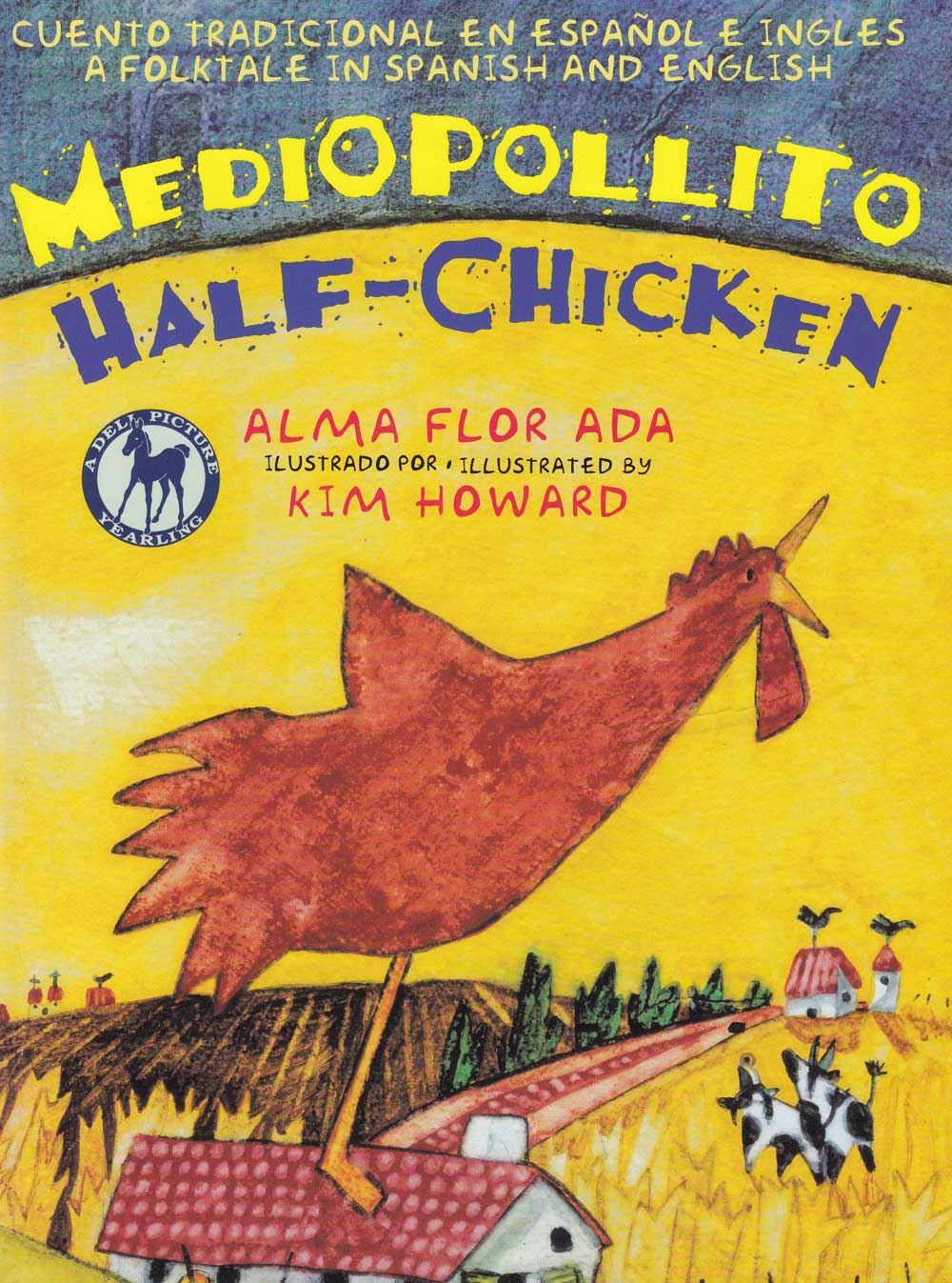
Mediopollito / Half-chicken
A Latin American Folktale in a Bilingual Edition
RECOGNITIONS
Aesop Award Accolade – American Folklore Association
Pick of the Lists – American Booksellers Association
Americas Commended List
BOOK DESCRIPTION
Have you ever seen a weather vane? Do you know why there is a little rooster on the top, spinning around to tell us which way the wind is blowing? Here is the answer in this old, old story about a very special chicken. With only one eye, one leg, and one wing, Half-Chicken sets off to see the world. His adventures take him far and wide, until at last he’s carried straight to the top in this lively, humorous retelling, in Spanish and English, of a traditional folktale. This traditional Hispanic folktale was set in colonial Mexico, to provide children with a glimpse of that period of Mexican history.
AUTHOR’S NOTE
As a young child I loved listening to my grandmother tell this story. Later this tale became a favorite for my children. Whenever I go, I look for weather vanes, since Half-chicken supposedly was the first weather vane. I enjoy seeing how many different shapes people have thought for this friendly artifact to tell the direction of the wind. One of my dreams is someday to travel around the world taking pictures of all the different weather vanes.
On retelling this story which my grandmother loved to tell, I chose her version, of collaboration, as opposed to other versions in which Half-chicken refuses to help when requested to do so, and ends up being punished, instead of helped. I know how much it meat to me as a child that Half-chicken misadventures would have a satisfying ending.
The welcoming received by the book and the joy of the hundreds of children to whom I have told the story add constantly to my unending gratitude towards my grandmother.
REVIEWS
School Library Journal
Pre-School–Grade 2: An adaptation of a Spanish folktale that explains the origin of weather vanes. The hatching of a chick with only one wing, one leg, one eye, and half the usual number of feathers raises quite a stir on a colonial Mexican ranch. All of the attention encourages the vain Mediopollito, Half-Chicken (as he is called), to seek his fortune. He encounters, in turn, fire, water, and wind and assists each of them during the course of his trip “to Mexico City to see the court of the viceroy!” In return, the elements come to the fowl’s aid and Half-Chicken finds his rightful place in the scheme of things. The repetitive and predictable nature of the tale makes it an appropriate read-aloud choice. The translation retains the meaning and flavor of the original Spanish, which appears alongside the English on each double-page spread. The folksy and brightly colored illustrations, “inspired by the patterns and texture of Mexican murals,” provide lively and interesting visual information. While the characters are at times a bit caricatured, this title remains a good addition to folklore collections. –Graciela Italiano, Weber State University, Ogden, UT
Booklist
Ages 4-8: Hip hop hip hop, Half-Chicken is off to Mexico City to see the court of the viceroy. Along the way, he helps the stream, the fire, and the wind, and they, in turn, help Half-Chicken when the viceroy’s cook tries to turn him into chicken soup. Finally, the wind blows Half-Chicken to safety atop a palace tower. “And from that day on, weathercocks have stood on their only leg, seeing everything that happens below, and pointing whichever way their friend the wind blows.” Ada gives her riotous retelling of this traditional folktale about the vain but helpful Half-Chicken a flavorful colonial Mexican setting. Howard matches the frolicsome mood and Hispanic setting with exuberant and glowing illustrations inspired by the patterns and textures of Mexican murals. Presented in a bilingual format and brimming with silliness and the simple repetition that children savor, this picture book is a jewel that will add a spicy sparkle to any folktale collection. –Annie Ayres.
The Horn Book
Noted translator and writer Ada has set her bilingual retelling of this traditional tale from Spain in colonial Mexico. As the humorous rather off-beat story opens, a mother hen hatches a chick with “only one wing, one leg, only one eye, and only half as many feathers as the other chicks.” Half-Chicken, as he comes to be known, gets a swelled (half) head from all the attention he attracts and decides to travel to Mexico City to show his uniqueness to the viceroy. Off he hops, stopping on his urgent quest only to unblock a stream impeded by branches, fan a small fire that is about to go out, and untangle a wind caught up in some bushes.”
“Half-Chicken finally reaches the viceroy palace, but instead of the hero’s welcome he expects, the little rooster is greeted with jeers and ignominiously thrown into a kettle on the kitchen fire. The good deeds Half-Chicken performed on his journey, however, literally get him out of hot water: the grateful fire tells the water to jump on him and put him out, and the water complies. Then, tossed out of the window by the frustrated cook, Half-Chicken is again rescued, this time by the wind, who blows him to the top of a tower. There, transformed into a weather-vane, he is forever safe from cooking pots. Ada’s liberal use of repetition, especially in describing Half-Chicken’s gait –“hip hop hip hop” –and the convention of the three helpers keep this rather unusual story grounded, with Howard’s vibrant, jaunty illustrations, rich in warm reds and golds and lively with pattern and texture, move the story forward with great energy. Her humorous depiction of poor scrawny Half-Chicken is particularly successful. ” (M.V.P., The Horn Book. November/December 1995)
Pick of the Lists
“A traditional Spanish folktale set in Mexico stretching the tale of a vain half-chicken who becomes a weather vane. Written in both Spanish and English (with full text in both languages), it is a welcome addition to the bilingual shelf. It is also a wonderful tale, painting the humor and delight of Mexico for those who cannot read or speak Spanish.” (“Pick of the Lists”, American Bookseller Magazine. August 1995)
Library Talk
“Alma Flor Ada’s Medio Pollito/Half-Chicken spins a Latin-American version of a Spanish tale explaining why weather vanes stand on one leg. English is one side of the double pages. Spanish on the other. A chick is born with only one wing and leg: a half chicken. He decides he is important enough to go to the viceroy’s court in Mexico City. On the way he helps some water, fire, and wind. When he ends up in a cooking pot in the viceroy’s palace, the elements help him escape to a rooftop, where he remains. Repeated themes will read well aloud. Kim Howard’s mixed-media double-page scenes present stylized details, often having the look of batik on cloth.” (Library Talk. May/June, 19996)
UC Davis School of Education
Summary: Alma Flor Ada retells a folktale in Spanish and English. The folktale is about how the weather vane originated. It is all told through the main character, Mediopollito, who is not an ordinary chick.
Recommendation for Parents: One of the most obvious benefits to this book is the fact that it is bilingual. Children should be exposed to different languages. The illustraitions are colorful and vivid. The book also has a very important message: it is ok to be different because we all have something to offer… More » – UC Davis School of Education, Read Aloud Recommendations
Americas Commended List
This well-done bilingual folktale explains why the weather vane has a little rooster on one end that spins around to show which way the wind is blowing. In contrast to the Ugly Duckling, here the unique and unlike-others chicken becomes vain from all the attention! Readers will find themselves exploring the unusual and brilliant illustrations.
Dozens of links to lesson plans, activities, and worksheets for all books in the series.
http://www.loveland.k12.oh.us/district/ technology/itech/les/reading/h.htm
http://urbanext.illinois.edu/eggs/res33-suggested.html
http://greatkidbooks.blogspot.com
READERS’ RESPONSES
Welcome Readers! Click to hear an interactive presentation by Mrs. Yencho’s 3rd Grade Rockin Readers! Enjoy!
If you have enjoyed reading or sharing this book, I would very much like to hear from you. Please click here to send your comments.
